Operation Thicket Probe

Operation Thicket Probe

Summer, 2-5 September 2005
Southeast Texas
Report compiled by Alton Higgins and Daryl G. Colyer
Revised 26 October 2008

INTRODUCTION

Congress passed legislation in 1974 establishing the Big Thicket National Preserve in Southeast Texas. Following an expansion incorporating creek areas and additional land in 1993, the preserve totaled more than 97,000 acres situated within an incredibly rich ecosystem. Managed by the National Park Service under the Department of the Interior, "the Big Thicket” is currently composed of nine land units and six water units. All are located between the Trinity and Neches rivers in Liberty, Polk, Tyler, Hardin, Jasper and Orange counties. What is sometimes referred to as "the Primitive Big Thicket" encompasses far more, reaching to the western fringes of the Sam Houston National Forest, and stretching nearly to Louisiana, in all totaling approximately 1,000,000 acres of forest.

Palmetto flats where loblolly pine saplings and young hard woods flourish in the Big Thicket. Photo: Chris Buntenbah


The Big Thicket is indeed a unique place, described by some scientists as one of the world’s most biologically diverse areas. Here the central plains, Gulf coastal plains, Eastern hardwood forests, and southeastern swamps all converge amidst a remarkable assortment of plants and animals. Predominant tree associations include mixed pine-hardwood forest, oak and sweetgum forest, loblollies and short-leaf pines, and bald cypress in the swamps and bayous. Wild hogs are abundant and deer are common; other species of wildlife include alligators, armadillos, bobcats, river otters, mink, beavers, an occasional bald eagle, and even, say some, cougars or panthers. At least 15 of the mammal species documented for Texas are unique to East Texas.

Swamp tupelos or black gum trees, dominate in this low-lying swampy area of the Big Thicket. Photo: Brad McAndrews


Average regional rainfall is roughly 55 inches per annum. Summers are hot and very humid; winters are short-lived and moderate.

BACKGROUND

Reports of an enigmatic animal inhabiting the dense woods and swamps of the Big Thicket have consistently surfaced for decades, dating all the way back to the area’s earliest settlers. The creature came to be known in the local vernacular by several names, such as the “wild man,” "mossyback," and "monkey man." Many of the local residents harbor absolutely no doubts that the creature represents an actual species, albeit mysterious and extremely elusive.

The Big Thicket receives abundant rainfall every year, as is evident by this mossy and rotted tree stump. Photo: Chris Buntenbah


Eye witnesses who manage to get a fleeting glimpse of one of these animals typically describe it as resembling a hairy, upright, bipedal man-like ape, exceeding at times seven feet in height, and occasionally accompanied by a strong odor. Eerie, loud, raspy, howling screams heard in the most remote places of the Big Thicket have been attributed to the wild man through the years. It is said to be a unique vocalization that is quite unlike that of any other indigenous animal. Investigators with the Texas Bigfoot Research Conservancy (TBRC) believe the wild man of the Big Thicket represents a Texas population of the species widely referred to as bigfoot or the sasquatch.

Terrain analyses and observations resulting from investigations of recent reports submitted to the TBRC, along with discussions with locals and National Park Service representatives, prompted the TBRC to initiate a field study in the Big Thicket.

Creeks and rivers wind through the Big Thicket. Photo: Chris Buntenbah


The unit chosen for the study was not originally where the TBRC had planned to focus their efforts. However, upon advice from Robb Riggs and National Park Service personnel, the TBRC changed the geographic focus of the study locale just a few days before the operation began. The specific location will remain confidential.

EXPEDITION TEAM

Investigators affiliated with the TBRC, Big Thicket historian and author Robb Riggs, and officials from the National Park Service, coordinated in planning and implementing the project. A film crew working on a television documentary for the Travel Channel accompanied the investigators for part of the study. Their presence served to fill the role of third-party independent observers, individuals with no background in or affiliation with bigfoot research.

Daryl G. Colyer – Field Investigator, Expedition Leader
Alton Higgins – Field investigator, Biologist
Jerry Hestand – Field investigator, Biologist
Monica Rawlins – Field investigator, Audio
Mike Street – Field investigator, Thermal Imaging
Mike Hall – Field investigator, Audio
David Peddy – Field investigator
Bruce Densford – Field investigator
Jimmy Chilcutt – Fingerprint Expert
Robb Riggs – Local Guide

EXPEDITION MISSION

To document the existence of the primate species referred to as bigfoot, sasquatch, or wild man in the Big Thicket of Southeast Texas.

EXPEDITION GOALS

To gain clear film footage of the target species;
To gain clear audio recordings of the target species;
To find, document and collect physical evidence of the target species’ existence, including scat, hair, tracks and manipulated vegetation.

EXPEDITION EQUIPMENT

Night Vision (first, second and third generation)
Nightshot video cameras
Thermal Imaging
Mini-disk recorders
Bionic ears
Portable call-blasting unit
Camera traps
Garmin GPS units with built-in two-way radios

METEOROLOGICAL CONDITIONS

During the day the weather was hot, temperatures fluctuated around 90° F, with occasional light breezes. Nighttime temperatures averaged around 70° F. The humidity was very high. Skies were generally clear.

The moon was in its new phase.

FIELD STUDY LOG:

Friday, 2 September 2005

Alton Higgins, Mike Street and Daryl Colyer arrived on site at about 14:00. The temperature was 87º F; the air felt quite humid. Street’s well-trained Red Heeler, “Speck,” also accompanied the men. As the three set up camp, Higgins discovered that the poles for his tent were not in its case, so he had to stay with Colyer in his tent, which had plenty of room.

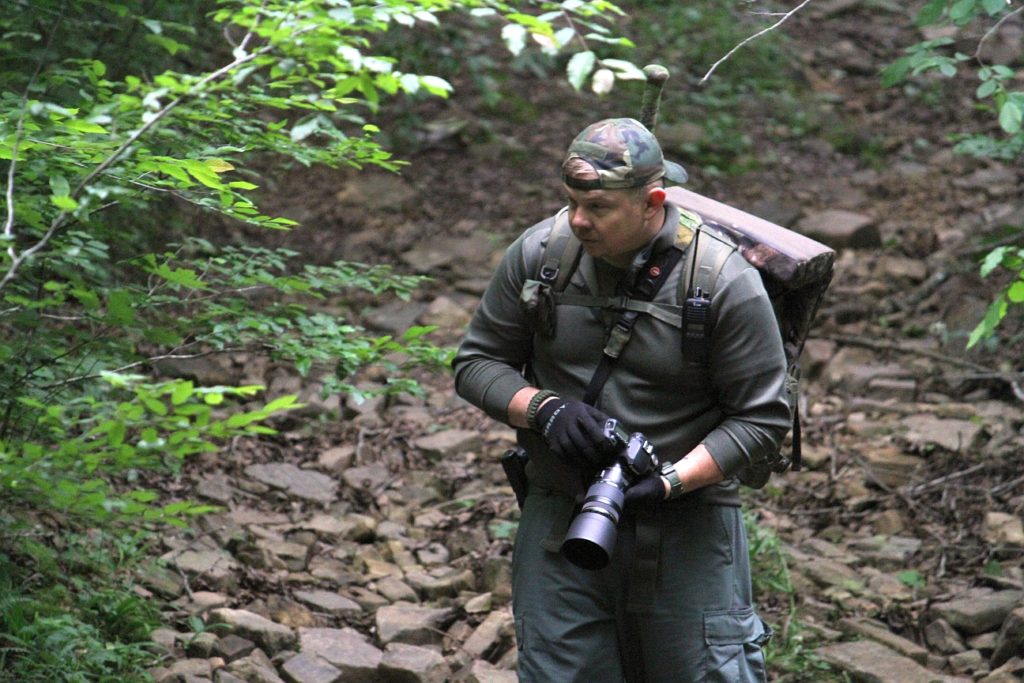
Alton Higgins and Mike Street conduct equipment checks before setting out for a cross-country hike. Photo: Daryl Colyer


Three others were expected to arrive later in the day: TBRC investigators Mike Hall and David Peddy, and Texas historian, newspaperman, editor and author Rob Riggs. Not knowing for sure when Hall, Peddy and Riggs were coming, and unable to reach them by phone, Street, Higgins and Colyer decided to hike down a gas pipeline right-of-way (a clearing through the forest) to check out the area. The pipeline was perhaps one half mile east of camp.

The three men hiked about four and one-half miles with the aid of Garmin GPS units, following the right-of-way south but cutting through the forest on their way back to camp, looking for any signs of wildlife. Hog sign was everywhere, and the men saw five or six of them shortly after the hike began. In fact, while they were still setting up camp, Colyer suddenly stopped working and said, “I smell a hog. Do you all smell it?” Neither Higgins nor Street smelled anything, but perhaps 30 seconds later Street spotted a small black hog about fifty yards away in the forest. Needless to say, Higgins and Street were impressed with Colyer’s ability to detect odors. The group did see a deer on the drive into the preserve; it appeared to be curious, but unafraid. However, they saw no other deer sign on the hike. The GPS units helped the investigators find their way straight back to camp at 18:00, where they found the other three waiting for them.

Michael Street. Photo: Daryl Colyer


The group spent the evening discussing plans and sightings in the area. Riggs was quite knowledgeable about the region, its history and its inhabitants, both human and non-human. The group decided to assume a passive role on the first evening and did nothing more than remain in camp; everyone turned in between midnight and 01:00. Nothing unusual was seen, heard or experienced.

Saturday, 3 September 2005

Higgins, who slept rather poorly, was the first to rise at approximately 06:00. After breakfast, everyone with the exceptions of Higgins and Peddy, took off to meet the film crew in Livingston. Higgins and Peddy, both college professors, used the time to talk, relax and enjoy some quiet time.

Colyer, Street, Hall and Riggs returned shortly after noon with the five-person television team: three women and two men. The crew wasted no time and was soon setting up to film interviews. Colyer’s interview was lengthy. He emphasized that the Texas version of the sasquatch is probably the same species as exists in the Pacific Northwest and that overall it does not appear to be an aggressive animal.

Colyer’s interview ended just before 14:00, the time when the team was supposed to meet with a National Park Service ranger in a nearby community. The entire team, along with the film crew, left camp and arrived at the meeting place a little late, but the ranger was there waiting. The ranger reviewed the team’s paperwork, including the scientific research permit as required and granted by the National Park Service, and gave the team a briefing on the “do’s and don’ts” of the Preserve. The ranger handed out his card and asked to be notified if the team had an emergency or otherwise found anything of interest.

Alton Higgins scans his surroundings with his binoculars. Photo: Daryl Colyer


On the way back to camp some of the investigators saw two large Russian boar-looking pigs and a large litter of piglets. The sighting reminded Peddy of a time when he had once been run up a tree (and kept there for hours) by a group of wild hogs.

More interviews were conducted upon the team’s return to camp. The interviews were lengthy, requiring several hours, and during this time the team was unable to perform equipment checks and conduct routine scouting ops; team members were asked to sit quietly while the film crew did its work.

Leslie Coffee, of Authentic Entertainment, Inc., Mike Street and Alexandria Gallo, also of Authentic Entertainment, as Street preps for an interview. Photo: Daryl Colyer


At approximately 16:30, Jerry Hestand and Monica Rawlins arrived.

Once the interviews concluded, the research team hurriedly prepared for nighttime operations. Colyer and Higgins conducted a quick briefing, apprising the team of the plan for the night.

As on other occasions, the TBRC investigators would implement LORD (listen, observe, record and document) protocols. The plan for the evening was to broadcast playbacks of putative sasquatch vocalizations and focus on the pipeline right-of-ways for accessing an area of interest and to try to get video. Hopefully, the investigators would see the animal(s) approaching the call-blasting site by way of one of the pipeline right-of-ways. Riggs was convinced, based on his experience and reports he’s investigated, that the species uses the pipelines as travel corridors.

Saturday evening, 3 September 2005

The whole group hiked out of camp at about 18:00. Prior to departure, Higgins reminded the investigators of past experiences in Oklahoma where it was believed that sasquatches had come into camps, perhaps in a search for food, and left handprints. There was also an instance in Texas earlier in the year when Colyer found fresh track evidence of a sasquatch 20 yards behind his tent. Hestand left a camera trap on a tree.

Jeff Daniels, one of the Authentic camera crew, sets up. Photo: Daryl Colyer


It took the team about an hour to make the two-mile hike south of camp. The group was divided into three teams:

Team Alpha – Colyer, Rawlins, Higgins and Riggs
Team Bravo – Street, Peddy and Hall
Team Charlie – Jerry Hestand in climbing tree stand

The television crew was divided between the two larger teams.

Higgins accompanied Hestand another two-tenths of a mile and helped him to get his climbing tree stand up a tall loblolly pine. By the time Hestand reached his perch, his clothes were wringing wet with sweat.

Upon Higgins’s return to Team Alpha’s position, Rawlins, Higgins, and Colyer attempted to set up the mini-disk recorder, but found that a necessary component was missing. Fortunately, one of the television sound techs was able to provide a replacement, but the team then determined that the microphone was faulty. Normally, of course, the team would have checked all the equipment before leaving camp, but they did not have much opportunity with the film crew conducting interviews. Team Alpha thought things might still turn out okay, because Team Bravo also had a recorder. However, something went wrong with that system as well, and nothing was recorded via audio recorder that night.

Jerry Hestand preps for the long hike. Photo: Daryl Colyer


Earlier in the day, Higgins had told Colyer that he had little or no confidence that the team would experience any sasquatch-related activity. The team had made a last minute decision to change the original choice for the study site, a Big Thicket unit where there had been recent sightings, to the unit where the team was now conducting research. Although the unit they were in had a long history of sightings, there were only two reported sightings in the last two years. The initial stillness of the night only seemed to confirm Higgins’s premonition; practically the only sounds the team heard were crickets and a few tree frogs, interrupted only occasionally by a barred owl.

The investigators planned to commence broadcasting vocalizations at 23:00.

At Team Alpha’s position, shortly before that time, one of the TV sound techs excitedly whispered for Higgins, Rawlins and Colyer to look at some strange lights faintly visible down the pipeline right-of-way to the east. Before long it became obvious that the lights came from ATVs and spotlights, and the sounds of humans shouting and engines roaring pierced the quiet night. The team was very surprised and dismayed, especially given that the area was federally protected and extremely remote. However, after making a brief appearance, the ATVs retreated and the team soon noticed that a couple of barred owls began calling back and forth. Higgins suggested that most animals, like humans, do not necessarily leave an area when faced with a disturbance such as noisy ATVs. Based on that premise, the team decided to proceed with operations. Due to the unexpected (and illegal) appearance of the ATVs, playback-broadcasting or call-blasting, was delayed until midnight.

The team as seen through Sony night-shot. Video still: Jerry Hestand


Sunday, 4 September 2005

The first round of playbacks at midnight did not result in any responses at all; even coyotes, animals that usually respond with much excitement when they hear the impressive “Ohio Howl,” were totally unresponsive. The team had heard coyote vocalizations earlier in the night, possibly a mile away, so they figured the canids were probably still within earshot of the loudly broadcasted playbacks.

It is worth pointing out that on a calm clear night, the playbacks can be heard by humans through the dense woods of East Texas at distances of over three miles. In the case of animals with superior hearing capabilities, such as canids, the earshot may be far greater than three miles.

At 01:00, Colyer played another round of playbacks. Higgins and Colyer first heard what sounded like a distant reply coming from the northwest; it was identical in pitch and duration to what they had played, identical in every way. In fact, it was so indistinguishable that Higgins and Colyer thought it was the television sound tech, sitting in the direction of the reply, playing back over headsets a recording of what they had just broadcast. Rawlins and the film crew also heard what sounded like a second distant return call. Again, the reply sounded identical in every way. The group listened as a series of long howls resonated through the Big Thicket. The calls were seven or eight seconds in duration, much longer that what coyotes, wolves or owls are typically capable of producing.

Higgins and one of the television team members rushed across the right-of-way clearing and asked the tech if she was playing back a recording. The sound tech, wearing headphones, appeared to be a little confused as she looked up at everyone and replied in a whisper that she was recording and not playing anything. The eerie calls continued, and Team Alpha and the film crew knew with certainty that they were hearing live vocalizations. An incredible series of six howls was produced. At that point, the television crew’s professional detachment vanished; they had become participants in their own story.

Colyer radioed the other teams to ask if they could confirm the reply vocalizations. Jerry Hestand had not heard them, but Mike Street, Team Bravo’s team leader, had heard them clearly. Street suggested shortening the duration between call-blasts from one hour to 30 minutes.

At 01:30, Colyer blasted again. Higgins asked Colyer to reduce the volume this time. It was reduced to 75% of full volume. Amazingly, the reply came again, the same as before, followed by a second howl. However, the second howl was quickly superseded by coyote vocalizations. Nevertheless, this time everyone in Team Alpha and Team Bravo, except for Robb Riggs who lay sleeping on the ground, heard the replies and confirmed the similarity to the “Ohio Howl.” Everyone who heard both replies agreed on the source of the second set of vocalizations. Although still distant, the howler was moving south; all agreed that it seemed to be approaching the teams' general location, roughly two miles south of base camp.

As best as the investigators could tell, the howler was traveling southward along the bayou. The team’s plan was based on the idea that the animal was familiar enough with the terrain to know about the pipeline right-of-ways, and that it would seek out the one where Team Bravo was located as a way to most conveniently approach the call-blasting position, the source of the sounds prompting its apparent interest, passing by cameras in the process. The investigators spent the next few hours listening and watching through night vision and the thermal imaging unit, but neither saw nor heard anything of an unusual nature.

The team presumed that the howler was still in the vicinity, but it had gone silent. Unfortunately, the reply vocalizations had not been captured on audio or video devices. The calls, while clear and distinct in the ears of the investigators and the film crew, were just too distant for the camera microphones to successfully pick up and, of course, the mini-disk recorders also failed to produce a successful recording of the incredible response vocalizations.

After several hours of no activity, the team decided to return to camp. Mike Hall reminded participants about the possibility of visitations to empty camps and the need to carefully observe for related evidence. After retrieving Hestand from the tree stand, all teams began the two-mile hike through the total darkness of the Big Thicket. All participants hiked as quietly as possible, using night vision and very little, if any, auxiliary light.

Upon their arrival back at camp, Higgins checked each of the seven or eight vehicles by flashlight for handprints, which he had found on several occasions in the past in Oklahoma. Higgins found a large, dusty mark at the top of the rear passenger-side window of the television crew’s rented Ford Expedition. It was very distinct and resembled, more than anything else, a huge handprint. When Higgins looked at the dusty mark more closely, he could see unmistakable lines that seemed to be  indicative of dermal ridges. A couple of smaller dusty marks also appeared to be related.

Higgins further noted that there were some unusual things about the largest of the dusty marks; even though it appeared to have been produced by a hand, it did not really look like the possible sasquatch handprints he had seen elsewhere. Those prints were extremely broad, whereas this one appeared to be rather narrow, comparatively speaking. However, the print was at the top portion of the window, which was quite high on this model of SUV, and it looked as if it may have continued onto the metal of the roof above the window, an area that could not be clearly observed, especially since it was still dark. The print appeared to be a “dust on dust” print, unlike what had been seen with other prints where the dust coating on a vehicle was removed after coming into contact with a hand.

The strange impression on the film crew's SUV. Photo: Daryl Colyer


The first thing Higgins did was to quietly summon the film crew camera operators. Without saying anything to anyone else, Higgins asked if the two men remembered seeing the odd markings on the window or if they had any explanation for them. They answered that they had no knowledge of the marks and, in fact, appeared to be totally stunned upon seeing what appeared to be a huge handprint.

In mere moments the whole camp was aware of the markings. Everyone took photos, and examined what appeared to be fat fingers (twice the width of human fingers) and their dermal ridges, theorizing as to the sequence of events and the placement of the various marks, etc. The reenergized film crew wasted no time and immediately began interviewing expedition members, asking for their reactions and opinions.

The investigators successfully prevailed upon the television crew to leave the vehicle at the camp and alter their travel plans. Jimmy Chilcutt, the investigators told them, perhaps the world’s foremost primate fingerprint expert, lived a little over an hour from the camp location. Higgins, Colyer and Street decided that they would try to get Chilcutt to look at the print. The film crew assured the team that, as far as they were concerned, the events of this night had become THE story of their trip and that they wanted to film Jimmy Chilcutt examining the find. The film crew seemed to be very excited about the print, but the investigators told them that no conclusions should be drawn until after a qualified expert had a chance to examine the find.

At 05:45, Colyer called TBRC director Craig Woolheater to describe the situation to him. Not being able to reach him, he left a message. Woolheater returned Colyer’s call at 07:30 and was briefed of the situation at that time. After getting Colyer’s assessment, Woolheater then spoke to Higgins. Higgins told Woolheater that, while the print did not really look like other purported sasquatch prints he had seen, it did resemble a very big hand and it showed dermal ridges. Woolheater told Colyer and Higgins that he would call Jimmy Chilcutt at 08:00.

The television crew unloaded the Expedition and somehow managed to cram their gear and themselves into their other vehicle and left for the comfort of their hotel rooms in Livingston. The TBRC investigators tried, without much success, to grab a couple of hours of sleep.

Woolheater called Colyer and Higgins around 08:00 and told them that he had talked to Jimmy Chilcutt at 07:50, who was eager to look at the print. Higgins called Chilcutt back to give him directions. He wanted to meet the investigators at 10:00, which was a lot earlier than the film crew would be able to meet again.

Upon arrival, Chilcutt immediately began to inspect the hand-like image. To Chilcutt's experienced eye, the dusty mark with its dermal ridges appeared as a unique grouping of four or more human prints involving the side of the palm (the “fat fingers”) and the forearm. Questions regarding how the “handprint” had been formed now began to arise.

Chilcutt explained that the “dust on dust” characteristic of the print, a feature that had piqued the field investigators’ curiosity, was a product of the oils and other skin secretions deposited on the glass by a hand and arm. As the Ford Expedition drove down the dusty road, the oils attracted dust to a greater degree than the surrounding glass surfaces, causing a greater buildup.

Jimmy Chilcutt dusts the impression. Video still: Jerry Hestand


It all made sense, but it did not explain how the marks had come to be located in such an unusual, extremely awkward to reproduce, position. Colyer then remembered seeing one of the cameramen leaning out the window to obtain footage of the forest and the other vehicles as they approached camp on Saturday afternoon. The window, on the rear passenger side of the Expedition, was not lowered all the way into the door, thus positioning the surface of glass where it was easy to imagine a hand and arm of the cameraman resting outside the vehicle and leaving the impressions as explained by Chilcutt. Chilcutt said that lowering the window to expose the top part, hidden when the window was fully raised, would almost certainly show more impressions from the cameraman, conclusively demonstrating in the process that the “print” was not created while the team was call blasting.

The only problem now was that the film crew was nowhere to be seen. They said they wanted to film Chilcutt examining the print. Chilcutt was okay with that idea, but he needed to get back to his house to prepare for his vacation and was anxious to leave. The investigators wanted the film crew to document Chilcutt’s analysis of the print, even though they knew it wasn’t from a sasquatch, because it was important to demonstrate that the TBRC was committed to objective expert analyses of evidence, whatever the results.

After several hours of waiting, the film crew arrived and went to work. Chilcutt explained the origin of the print, telling them that he had initially thought it was quite intriguing until he had a chance to examine it closely. The SUV’s window was lowered, showing the evidence he predicted. Chilcutt had solved the mystery.

Because of the remarkable vocalizations heard the previous evening, the investigators wanted the crew to spend another night, but they were not able to do so. Chilcutt also had to depart; Rob Riggs had left earlier in the afternoon; Hall and Peddy also decided to leave. They were replaced by Bruce Densford, who arrived at approximately 18:00, just as the film crew was wrapping up with Chilcutt.

The investigators began to prepare for the coming night’s operations. Rawlins and Colyer concentrated on getting mini-disk recorders ready to go, which they succeeded in doing. Meanwhile, Mike Street studied a topographic map and asked Rawlins, Colyer and Higgins to help him in trying to estimate the location of the howler heard the night before; Hestand and Densford also gathered around the map. Based on the group’s directional estimates from two positions, it seemed clear that the animal they heard was situated on the west side of the bayou that was west of camp. This was a large area that appeared to be inaccessible by road. The investigators referred to it as “the bubble” because of the general shape of the area as shown on the topographic map.

The plan for this evening would be to focus on “the bubble” with playbacks. First, however, the team planned to bed down around sunset to get some much-needed sleep. At midnight, the team of six would arise and go to work.

Street, Higgins and Colyer had probably caught no more than about four hours of decent sleep in the last two days. The adrenaline fluctuations and the physical exertion of the last 48 hours had left them pretty drained. Even Rawlins and Hestand, who had arrived on Saturday, were quite depleted and in need of rest. Densford was the only member who was fresh and well rested, having just arrived at the campsite. Before long, everyone but Densford was overwhelmed by sleep.

The respite lasted a little more than an hour.

At approximately 20:40, Mike Street roused Colyer and Higgins from sleep. He had been awakened by an extremely loud, arching scream coming from one hundred yards or so east of camp. Jerry Hestand heard the scream as well, as did Bruce Densford, who was awake at the time and sitting in his vehicle. Hestand hurriedly woke Rawlins, who also was sleeping and did not hear the howling scream.

Higgins and Colyer rushed outside; Higgins went to work trying to locate and set up one of the mini-disk recorders, wishing for access to a system for constantly recording high-quality sound while in the field. The investigators were all too aware that they had missed documenting several possible sasquatch vocalizations over the last few years because of poor quality equipment, equipment failures, or other human-related glitches.

The night was perfectly calm. Suddenly, at approximately 21:03, again a long loud raspy scream, starting at a high pitch and descending, erupted from the darkness.

The group noted that it was sort of an “Aaaaaahhhhhh” sound, powerful and prolonged, nothing like the “whoo-ahh” part of a barred owl vocalization, and nothing like a coyote call.

Street asked Rawlins to scream, reasoning that it might generate a response. She did so a couple of times, but her cries sounded thin, feeble, and abbreviated in comparison with what everyone present had now heard. Rawlins's screams were singled-toned, and in no way compared to the powerful vocalizations that the group was hearing. The unknown vocalizations were clearly multi-tonal, and consisted of several simultaneous prolonged notes, similar in nature to bagpipes, a train whistle or harmonica (in terms of multi-tonal qualities). Whatever was responsible for the vocalizations seemed to clearly have unique attributes. There was no vocal response to Rawlins's comparitively insignificant shrieks.

The group turned on no lights, standing around in the pitch darkness and quietly listening, occasionally having a whispered discussion about what course of action to take. The investigators decided to stay in camp rather than travel away to the destination originally selected. Gibbon whoops would be broadcast in an attempt to record a nearby response vocalization.

At 21:20, Colyer responded with playbacks of siamang gibbon whoops. At approximately 21:24, two more raspy howling screams were heard, seemingly in response to the gibbon whoops. Opinions differed regarding the distance to the screamer; some thought it might have been as far as two to three hundreds yards away, or even farther. If that was the case, the volume of the screams, penetrating through dense forest at such a distance, was all the more remarkable.

At 21:50, Colyer responded again with playbacks. Within a minute, another raspy howling scream resonated from the direction of the pipeline; the screamer was perhaps 300 yards southeast of camp.

The group sat quietly, listening. Former Army Ranger Street and his dog Speck crept slowly and silently through the thicket toward the pipeline, thermal imager and nightshot camera equipped with night vision at the ready.

At about 22:10, Colyer made one more broadcast. There was no response.

Colyer joined Street and the two methodically probed the surrounding woods using night vision. Nothing was seen or heard.

Bad luck with the mini-disk recorder continued; none of the screams were recorded on mini-disk. Fortunately, Jerry Hestand managed to record one of the screams using a video camera. However, what was recorded on tape did not sound nearly as loud as it did in person.

Monday, 5 September 2005

Four of the team members took Densford’s vehicle, which was very quiet, and drove nearby preserve roads using only night vision and cameras, but no undocumented species of wildlife were observed. Finally, total exhaustion hit. At 02:40, the team retired to their tents. Just before turning in, Higgins again installed a blank disk and started up a mini-disk recorder. It would, hopefully, record any vocalizations that occurred during the next couple of hours while the team slept.

At some point during the night, Colyer woke Higgins and quietly asked him if he smelled anything unusual.

Higgins could not detect any unusual odors.

Colyer insisted that he smelled a strong odor, "like zoo animals," and told Higgins that it reminded him of what he smelled immediately after his own close-range sighting of a sasquatch.

The two drifted off again to sleep.

Next, Higgins recalled “something” waking him. Minutes had passed, perhaps hours; he had no idea what time it was. He lay there momentarily in silence, listening.

Abruptly, the quiet was shattered by what Higgins described as a very close-range “astonishing noise.” Higgins heard “a savage sounding, huge sounding, growl or roar” erupting from the forest, south and east of Mike Street’s tent. The sound was very close, and unlike anything Higgins, a former wildlife biologist in Arizona with countless hours of field time under his belt, had ever heard.

Higgins recalled lying there momentarily stunned. He tried to make sense of the powerful commotion, but it was confusing. The sound was ongoing, constant, but it dawned on Higgins that there seemed to be a rhythm or regularity to it.

After what may have been fifteen seconds or so, Higgins realized that Colyer was sleeping through the cacophony. Higgins punched Colyer, who had fallen out of his cot and landed on top of Higgins. Colyer awoke, hearing the bizarre and, frankly, frightening roars. Colyer believed that he was hearing what he thought was Speck, Mike Street's red heeler, growling while another much louder, unidentified animal ferociously and continuously growled back.

After fumbling around in the dark, the two found a strong but red-lensed flashlight and got up on their knees, facing in the direction of the ongoing growls. Shining the light through the mosquito netting of the tent’s sloped roof, Colyer tried to wake Street, sleeping just a few feet away inside his one-man tent, but got no response. Colyer and Higgins scanned the woods with the flashlight, but they couldn’t see much past the vegetation ringing the camp.

At that time, Hestand awoke to the loud strange growls. Like Colyer and Higgins, he initially believed he was hearing two different animals. Hestand also thought the sounds were right outside his sleeping quarters.

To the three men, the guttural noise appeared to be coming from a single source. It was as if an extremely large animal, or at least one capable of generating a huge vocal racket, was producing sound as it both exhaled and inhaled, because the sound was incessant. The sound varied in quality, alternately changing from a very low-pitched rumbling roaring growl to a slightly higher-pitched sound incorporating a sort of gasping wheeze.

The wild noise stopped as suddenly as it began. The investigators heard no other sounds, no footsteps, no limbs breaking, nothing. Street, Rawlins and Densford never awoke; incredibly, they remained in deep sleep through the entire occurrence.

This sound heard by Higgins, Hestand and Colyer was similar, yet much deeper, lower-pitched, and much longer in duration, to this sound of a black howler monkey.

Still somewhat in a state of shock, Higgins and Colyer lay back down. They were unaware that anyone else was awake. Hestand remained in his sleeping bag and continued to listen for a while. Colyer and Higgins sincerely hoped that the mini-disk recorder had captured the amazing vocalizations. Overcome by fatigue, the three eventually went back to sleep. Rawlins, Densford and Street had amazingly slept through the entire ordeal.

Higgins was awakened again, this time by something just outside the tent. An animal heavily thumped his body, settling against him through the tent wall. He then realized that it had to be Speck. For some reason she snuggled up as close as she could get to him through the tent wall. She stayed there through the remainder of the night. She had started out in Street’s tent, as usual; evidently she found her way out when she sensed the presence of the visitor, but she could not get back in. Higgins surmised that she was afraid and needed the reassuring presence of physical contact.

Colyer, Higgins and Hestand later estimated that the visitor episode had lasted about one minute. This time the mini-disk had faithfully recorded nearly two hours of nighttime sounds, including occasional snores from the tired occupants of the tents, but the disk expired and so the machine had stopped recording prior to the arrival of the unseen visitor. The loud growling visitor had approached camp some time after 04:30, and well before sunrise, but the bizarre, growling vocalizations were not recorded.

The team got up early that morning as Densford was leaving. Higgins, Hestand and Colyer discussed what had happened and informed Rawlins and Street of what they had heard. Street, Hestand, Colyer and Higgins, all still quite tired, made a wide reconnaissance of the area east of camp, but found nothing related to the target species.

The investigators did encounter three wild “razorback” hogs. Colyer came within 20 feet of one large boar. The hog snorted and locked eyes with Colyer, and both froze. Suddenly, the hog broke, running off in the direction of Street, snorting all the while.

Shortly thereafter, the men returned to camp. Long hours of driving awaited everyone, so they broke camp and left for home at approximately 10:00.

EPILOGUE

In the wake of the weekend’s compelling events, and the repeated difficulty in obtaining much desired recordings of distant and close vocalizations, Street and Colyer researched high-end recording systems suitable for outdoor use. Following the recommendations of experts from Cornell University’s Lab of Ornithology, the TBRC purchased state-of-the-art components, including a Marantz PMD670 digital recorder for uncompressed recording capability, a Hitachi 6 GB microdrive to enable uninterrupted audio recording for up to eight hours, a Sennheiser MKE102S/K6 omni-directional microphone, and other items to complete a package capable of recording anything audible to the human ear.

DISCUSSION

As illustrated in this report, the TBRC has endeavored to be as straightforward as possible in reporting the objectives, methods, and results of field endeavors. Things do not always go as planned, and that was certainly true in the case of Operation Thicket Probe. You do the best you can, assess yourself as objectively as possible, and then try to apply the lessons learned. The effective pursuit of objectives is certainly limited, in part, by the availability of resources, including time, finances, information, personnel, equipment, etc. The scope of the sasquatch documentation effort is daunting, but we believe we are steadily making progress in small increments.

The TBRC has been conducting field experiments, documenting results, and repeating the process. Unidentified vocalization recordings, purportedly of an undocumented North American primate, and other primate vocalizations, have elicited unidentified kindred response vocalizations in areas where there have been reported sightings of an unidentified primate-like creature and track finds of an unidentified biped. Unbiased local, state, and national media representatives have corroborated these events.

Furthermore, we are now convinced that, on more than one occasion, we have not only elicited response vocalizations but that we have drawn in these animals as well. Careful preplanning helps to set the stage for such results, along with a healthy dose of good luck. There is no guarantee of success; however, during TBRC field research operations,  probable close-in experiences have occurred, perhaps as an outcome of broadcasting playbacks. For example, during the above mentioned research operations, TBRC investigators have had one visual of an unidentified animal matching the description of a sasquatch and found track evidence in close proximity to a camp matching the described foot track of a sasquatch, both in areas with a high number of reported sightings of bipedal apelike animals.

Future plans include obtaining more test results from areas where response vocalizations would not be predicted, based on an absence of sighting reports and other factors. This would provide a larger base of experimental controls to provide comparative data. However, the rarity and apparent intelligence of the species support the use of great discretion when employing the recordings at locations of high interest, that is, places where investigators have grounds to predict the presence of one or more of the animals. Acclimatization of individual sasquatches to the recordings, that is, linking the sounds to human activity, is a serious concern.

ACKNOWLEDGEMENTS

The Texas Bigfoot Research Conservancy wishes to express appreciation and gratitude for the cooperation and assistance of the National Park Service. Also, deep thanks to the many individuals who had the courage to report their encounters.

Incident reports by region

Click on a state:

Findincidentreports-map

Or select a state and county:

Recent incident reports

RSS

Occurred 9/22/1995 in Vernon Parish County, LA

Published on November 9, 2009 Icon-photo Icon-video

Former Fort Hood pilot reports dusk highway encounter a few miles east of Sabine River. Read more...

Occurred 7/15/1972 in Burleson County, TX

Published on October 21, 2009 Icon-photo-off Icon-video-off

While camping, family hears loud vocalizations. Read more...

Occurred 11/24/1994 in Little River County, AR

Published on October 17, 2009 Icon-photo Icon-video-off

Hunter has dusk encounter along railway outside of Wilton. Read more...

Occurred Fall 1997 in San Jacinto County, TX

Published on August 13, 2009 Icon-photo Icon-video-off

Sam Houston National Forest: while taking daughter's friends home, mother has roadside visual encounter. Read more...

Occurred 4/1990 in Palo Pinto County, TX

Published on August 11, 2009 Icon-photo Icon-video-off

Two fishermen report early morning road encounter while enroute to Possum Kingdom Lake. Read more...

Occurred 5/1985 in Little River County, AR

Published on August 5, 2009 Icon-photo Icon-video-off

Couple has dusk roadside encounter north of the Red River on Highway 41. Read more...

Occurred Summer 1986 in Rains County, TX

Published on August 4, 2009 Icon-photo-off Icon-video-off

Camper claims to have visual encounter on shore of Lake Tawakoni. Read more...

Occurred 6/22/2009 in McCurtain County, OK

Published on July 11, 2009 Icon-photo Icon-video-off

Family hears vocalizations and finds possible track. Read more...

Occurred 9/2007 in Montgomery County, TX

Published on June 30, 2009 Icon-photo-off Icon-video-off

Worker has early morning visual encounter while working on construction of Fox Sports Facility. Read more...

Occurred Fall 1970 in Canadian County, OK

Published on March 10, 2009 Icon-photo Icon-video-off

Coon hunter reports late night visual encounter on Canadian River in Central Oklahoma. Read more...

View all sightings...