
Last updated on January 25th, 2023 at 10:13 am
The NAWAC’s approach toward wood ape, or sasquatch, documentation includes tried and true mainstream techniques employed by wildlife researchers.
Although the pursuit of such a target species may be considered by some to be controversial and/or frivolous, the pursuit of putative species based on limited physical evidence and copious anecdotal reports is not without historical precedent. Indeed, throughout history naturalists have discovered new species by following up on anecdotes and sighting reports. In light of these historical precedents, the fact that the fossil record clearly provides a few possible candidates of lineage for the sasquatch should serve to advance the proposal that this enigma is indeed worthy of scientific investigation.
In order to explain the sasquatch phenomenon, the NAWAC hypothesizes that an intelligent, large, shy and elusive bipedal primate exists in North America, particularly in the lush densely forested contiguous regions of Arkansas, Louisiana, Texas and Oklahoma. It is probably quite rare. The primate hypothesis is based on large numbers of anecdotal encounter reports from reliable observers, physical evidence found in the region and elsewhere in North America that seems to provide support for the anecdotal reports, and field observations made by NAWAC investigators and advisors.
The NAWAC is engaged in activities designed to test and/or validate the hypothesis through a process involving the collection of observer reports, trace evidence, recorded audio, and clear, repeatable, indisputable photographic/videographic images.
Collection of Observer Reports
Typically, the first of the NAWAC’s methodology layers involves the collection and subsequent investigation of observer accounts. Contemporary field biologists often rely upon indigenous people to determine starting places in which to conduct searches for species rumored to exist. NAWAC investigators have conducted comprehensive investigations of reported encounters for this very purpose since 1999. In the process, they have interviewed hundreds of individuals claiming to have encountered a wood ape.
The NAWAC website provides a means for individuals claiming to have had an encounter with a wood ape to report the incident. Upon receipt of a report, the NAWAC Field Research Coordinator appoints at least one investigator to conduct a thorough investigation of the incident. Other observer data are collected through public meetings or word of mouth, with the observer then being directly contacted by NAWAC volunteer investigators. All witnesses are interviewed directly and as comprehensively as possible, with onsite investigations typically being conducted only where the events are more recent (usually less than five years old).
The website also provides a public repository or database of past reports deemed reliable by NAWAC investigators. Although the NAWAC’s database of reported incidents predominantly focuses on the Arkansas, Louisiana, Texas and Oklahoma region, reports from other states are sometimes submitted. We have many investigators across the country that may look in to the report further.
Once a report has been comprehensively investigated, an internal assessment is made pertaining to its reliability factor. A classification system patterned after those in use by other wildlife organizations is employed by the NAWAC to assist in this process. The system allows investigators to assign one of four categorization levels to investigated reports, facilitating more precise evaluations regarding reliability (not to be confused with witness honesty).
Briefly, reports involving a sighting, and accompanied by another form of support, are assigned to Class 1. Reports involving sightings by professionally trained or highly skilled observers are assigned to Class 2. Sightings or possible wood ape evidence reported by credible witnesses are assigned to Class 3 (the most commonly assigned category).
Investigated events that do not pass the corroboration, competency, or credibility tests, including second-hand accounts or reports that involve unusual sounds only (i.e., no additional forms of evidence), are assigned to the Class 4 category. More detailed descriptions and explanations are provided below.
Class 1: Corroboration
- 1A. A wood ape specimen has been collected (alive or dead); or,
- 1B. A report investigation results in a wood ape or sasquatch observation or the documentation of clear tracks or other forms of physical evidence by an investigator; or,
- 1C. An investigator determines that a visual encounter with a wood ape, or sasquatch/bigfoot by a very reliable observer is a distinct possibility, there is tangible corroborating evidence, and all other sources can be ruled out; or,
- 1D. A visual encounter with a wood ape is a distinct possibility involving two or more reliable observers, and all other sources can be reasonably ruled out.
Class 2: Competency
Investigator determines that a visual encounter with a wood ape is a distinct possibility, the observer is exceptionally trustworthy, professionally trained, and experienced in the outdoors and/or is accustomed to looking for and recording details (e.g., biologist, anthropologist/archaeologist, ranger, trapper/tracker/seasoned hunter, bird watcher, game warden, naturalist, law enforcement), and other explanations can be reasonably excluded.
Class 3: Credibility
- 3A. Investigator determines that a visual encounter with a wood ape is a distinct possibility, the observer is credible, and all other sources can be reasonably ruled out; or,
- 3B. Unidentifiable vocalizations were reported and there is accompanying tangible evidence to possibly indicate the presence of a wood ape, the observer is very reliable, and other sources can be reasonably ruled out; or,
- 3C. No visual encounter occurred, but physical evidence was found to indicate the presence of a wood ape (tracks, hair, scat, etc.), the observer is very reliable, and other sources can be reasonably ruled out.
Class 4: Questionable
This classification applies to sound or vocalization-only reports, with no corroborating evidence, and to second-hand reports. While the observer(s) may be reliable, the possibility of misinterpreting outdoor sounds and nocturnal vocalizations can be great. These reports will not be made available for public review, but they will remain in the NAWAC database as Class 4 reports.
Have you had an encounter? Please tell us about it.
Spurious Reports
A majority of reports submitted to the NAWAC are invalid. Among these reports are a large number of jokes, fabrications, and attempts to hoax, or the submitter did not provide valid contact data. Then there are reports, submitted by people who are probably honest, that represent simple misidentifications; the observers saw or heard something that was mistakenly identified as a bigfoot.
In some cases a report is so obviously fabricated that no investigation, beyond an initial perusal, is necessary. In other situations investigators determine, upon reasonable scrutiny, that the report was likely fabricated.
All invalid reports are appropriately designated and retained in the NAWAC’s internal database for analysis purposes.
Generally speaking, for every report the NAWAC receives that is deemed as credible, approximately ten are submitted that are spurious or invalid.
Collection of Trace Evidence
Field research results when volunteer NAWAC investigators and/or biologists determine that it may be possible to collect physical trace evidence of the target species, based on how recent and reliable a reported incident may be. Volunteers then conduct searches for trace evidence. Searches for the collection of trace evidence generally involve techniques akin to those employed by primatologists in pursuit of other rare species and/or known higher order primates such as orangutans, chimps, bonobos and gorillas. Trace evidence may consist of tracks, hair, scat, nests, and animal remains. In addition, sound recordings of vocalizations are sometimes attempted. This may involve field vocalization playback experiments, a technique used by some primate researchers.
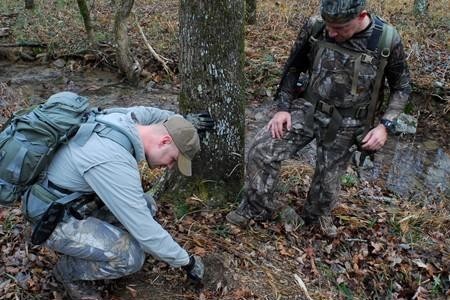
Upon performing a preliminary field and/or in-house analysis of collected evidence and concluding that it is of interest pertaining to the target species, NAWAC investigators submit the evidence to competent scientists or specialists in pertinent fields for lab analysis.
Collection of Photos/Videos
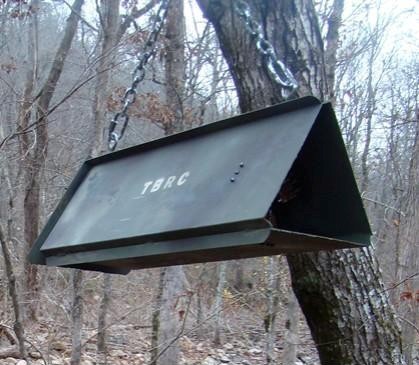
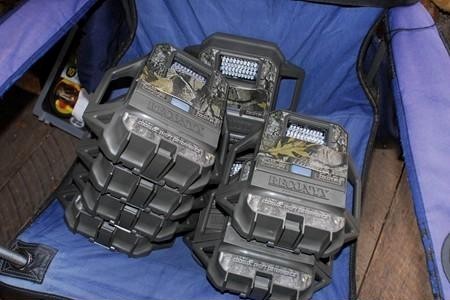
From 2006 to 2012, NAWAC field research included the long-term deployment and maintenance of camera trap arrays in remote areas. These are areas that have generated a number of reliable observer reports, both recently and historically, and produced trace evidence and/or facilitated direct NAWAC investigator field observations. While this may or may not be sufficient to officially classify or name the species, it would represent an important step in that direction.
In 2020, the NAWAC started conducting a camera array trap known as Hadrian’s Wall.
“I think a hard-eyed look is absolutely essential.”
– Dr. George Schaller

